Blog AI and Agents · Beyond the Four Walls · Part 6
Amazon wants to be where the agent buys. What is your Amazon?
Amazon built its own shopping agent, sent it to buy on other brands' sites, and fought to keep outside agents off its own. Part 6 of Beyond the Four Walls: what that playbook teaches a gym, studio or spa.
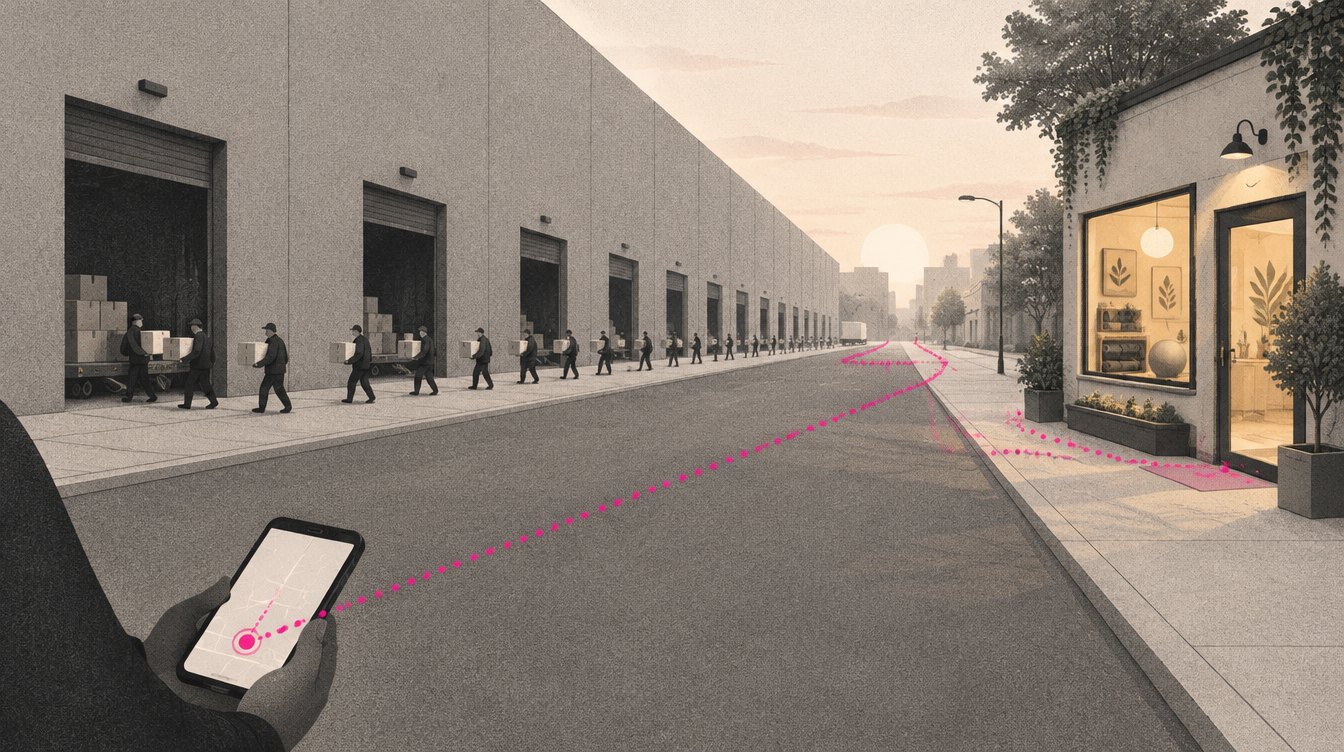
Amazon does not sell pilates classes, facials or memberships. So it is fair to ask why a studio owner should spend ten minutes on Amazon's AI plans. The answer is that Amazon has thought harder than anyone about one question every local business now faces: when software does the shopping, who controls where it buys?
Amazon's answer has three parts. Build your own agent and make it the place customers start. Send that agent out to buy from other people's stores. And keep outside agents from shopping in yours unless they play by your rules. Watch how those three moves fit together and you will see the same fight coming to the appointment book.
Amazon's own agent is already huge
Amazon's shopping assistant launched as Rufus. On May 13, 2026, Amazon renamed it Alexa for Shopping and, as Modern Retail reported, brought the capabilities of Alexa+, its rebuilt voice assistant, into the search bar. Whatever the name, the numbers Amazon reports are big and climbing.
In its third quarter 2025 results, Amazon said 250 million customers had used Rufus that year and that shoppers using it were 60% more likely to complete a purchase. By the fourth quarter release it was 300 million+ customers, "helping deliver nearly $12 billion in incremental annualized sales last year." On the July 30, 2026 earnings call, Andy Jassy said over 350 million customers had used Alexa for Shopping in the past 12 months, with active users nearly doubling in the quarter.
Source: Amazon Q4 2025 release and Q2 2026 call; PYMNTS Intelligence as reported by Forkast
Source: Amazon earnings releases (October 2025, February 2026) and Q2 2026 earnings remarks (July 30, 2026). The assistant was called Rufus until May 13, 2026. The periods differ slightly, so read this as direction, not a precise growth rate.
A word of caution on those figures. They are Amazon's own, and the sales number rests on Amazon's attribution method. The 40% claim compares people who use the assistant with people who do not, and people who ask a lot of questions may simply be keener buyers to begin with. Still, the direction is not in doubt, and neither is the strategy: Amazon wants the conversation with the assistant to be where shopping starts.
Its agent shops other people's stores
The second move gets less attention. Amazon's assistant does not stop at Amazon's shelves.
Amazon's Buy for Me feature lets a customer buy an item from another brand's own website without leaving the Amazon app. The customer taps a button, confirms on an Amazon checkout page, and Amazon passes their encrypted name, address and payment details to the brand's site to finish the order. The brand handles delivery and returns. Amazon describes it as a beta for a subset of US customers.
In March 2026 Amazon said its Shop Direct program, which shows products from outside stores, now covers 100 million products from more than 400,000 merchants, and that tens of millions of those can be bought through Buy for Me, as reported by Digital Commerce 360. Merchants can now send Amazon a product feed instead of waiting to be crawled.
Think about what that means for the brand. The sale happens on its website, technically. But the customer started in Amazon, compared in Amazon, paid with their Amazon card and will check the order status in Amazon. The brand is fulfilling. Amazon is the relationship.
It keeps other agents out of its own store
The third move is the fence. Amazon wants its agent shopping everywhere, and it wants a say over which agents shop at Amazon.
| Date | What happened |
|---|---|
| November 2025 | Amazon sued Perplexity in federal court in San Francisco, alleging its Comet browser agent shopped through customer accounts while disguised as an ordinary Chrome browser. |
| March 2026 | Judge Maxine Chesney granted Amazon a preliminary injunction, finding "strong evidence" that the agent accessed Amazon without authorization. |
| August 4, 2026 | The Ninth Circuit vacated that injunction, finding the user, not Perplexity, was the one accessing Amazon. Contract and terms-of-service claims were left open, and the case continues. |
| September 21, 2026 | Amazon blocked Meta's new Muse agent from shopping on Amazon.com. |
The Muse block came with a pop-up that users started seeing that day, as reported by Adweek:
"Continued access by an unauthorized AI agent violates Amazon's Conditions of Use, to which our customers have agreed."
Amazon's stated reasons are worth reading closely. It told Adweek that agents shopping on a customer's behalf bypass Amazon's personalization, so customers miss recommendations, and that Muse did not identify itself. It listed what it wants from agents: operate transparently, offer an opt-out, provide a mutual value exchange and improve the customer's experience.
Some of that is about security, and some is plainly about who owns the customer. Both can be true. The court fight shows the law is unsettled: the Ninth Circuit's August ruling, as summarized by the law firm Cooley, says anti-hacking law may be a weak tool against an agent acting for a user, while leaving other legal routes open. For a business owner the practical takeaway is simple. Even Amazon, with every lawyer it could want, cannot fully decide which agents walk through its door. You will not either. What you can decide is how easy you are to book well.
Where Alexa meets the appointment book
Alexa+ is where this stops being a retail story. Amazon made Alexa+ available to all US customers on February 4, 2026, free with Prime and $19.99 a month without it. Amazon's own page says it can order takeout, make restaurant reservations, book rides and schedule services such as home repairs. In his shareholder letter, Jassy wrote that customers are completing purchases on devices three times more with the new Alexa.
Then there is the line that should get a salon or spa owner's attention. Amazon announced that Alexa+ is teaming up with Square so customers can find providers "including spas, hair and nail salons, barbershops, and more," and "make, manage, and reschedule appointments with service providers directly through Alexa." The same page says Amazon has seen strong engagement with Thumbtack and Vagaro. Amazon says these integrations are coming in 2026. I could not confirm that the Square booking feature is live yet, so treat it as announced, not shipped.

Your Amazon is not Amazon
A gym or a med spa will never sell on Amazon. But every local business has its own version of Amazon: the place an agent will go first because buying there is easy. Today that is a short list.
- Google. Google Search and AI Mode, fed by your Google Business Profile and, for some categories, by booking platforms. Google's AI Mode already books beauty and wellness appointments in a test program, as we covered in Part 1. That is the subject of the next part.
- Your booking platform. Square, Vagaro, Mindbody, Booksy, Fresha and the rest are becoming the doors agents use. Alexa+ is wiring in Square. Google named Booksy, Fresha and Vagaro.
- Aggregators. Class and treatment marketplaces that list many studios side by side, with one login and one payment method. Agents will love them for the same reason shoppers do.
Each of these is useful. Each also turns you into a row in someone else's list. And a row in a list, read by a machine, tends to get judged on the things a machine can compare: price, distance, the next open slot. That is how a business becomes a commodity line in someone else's agent.
A commodity line in someone else's agent
Listed only through an aggregator, often at a discount. Generic class names. Price and time are the only things the agent can read. The customer's account, card and history live with the platform.
A business the agent books by name
Bookable on its own site and through the platforms it chooses. Offers named and described in plain text: what the intro class is, who teaches it, what is included. Policies and prices readable by a machine. The customer joins, pays and gets remembered by the business.
Amazon's own behavior tells you why the second column matters. Amazon fights for the relationship: the account, the card, the order history, the recommendation. It is willing to let a brand ship the box as long as Amazon keeps the customer. A local business should want the mirror image: let any reasonable agent find and book you, and make sure the member ends up on your books, not only in someone else's app.
What to do before the agents arrive
The pattern to remember is Amazon's: own the place where the agent starts, be present where it shops, and set terms for how it gets in. You cannot build Alexa. You can make sure that when Alexa, Google or anyone else goes looking for a spa on Saturday, the one it finds and books is clearly, specifically you.
Next, in Part 7, we look at the platform most likely to send that agent your way: how Google AI Mode books the appointment. If you missed the earlier argument about why agents now check whether they are welcome at all, start with Part 1.
Sources
- Amazon, "Amazon Q3 2025 earnings report: Read the release," October 30, 2025. aboutamazon.com
- Amazon, "Amazon Q4 2025 earnings report: Read the release," February 5, 2026. aboutamazon.com
- Amazon, "Q2 earnings: CEO Andy Jassy on Amazon Stores growth, delivery speed, and AI shopping," July 30, 2026. aboutamazon.com
- The Motley Fool, "Amazon (AMZN) Q2 2026 Earnings Call Transcript," call of July 30, 2026. fool.com
- Amazon, "Amazon CEO Andy Jassy's 2025 Letter to Shareholders," 2026. aboutamazon.com
- Amazon, Rufus announcement page with editor's note on the May 13, 2026 rename. aboutamazon.com
- Modern Retail, "Marketplace Briefing: Why Amazon discontinued its AI-powered Rufus chatbot for Alexa shopping agent," May 14, 2026. modernretail.co
- Amazon, "Amazon's new 'Buy for Me' feature helps customers find and buy products from other brands' sites." aboutamazon.com
- Digital Commerce 360, "Amazon opens up new AI-enabled Buy for Me, Shop Direct options for merchants," March 11, 2026. digitalcommerce360.com
- Amazon, "Expedia, Yelp, Angi, and Square to build new agentic experiences for Alexa+." aboutamazon.com
- Amazon, "Alexa+ available free for Prime members in the US." aboutamazon.com
- MacRumors, "Amazon's Alexa+ Now Free for All U.S. Prime Members," February 4, 2026. macrumors.com
- Retail Insight Network, "Amazon sues Perplexity over agentic AI shopping," November 6, 2025. retail-insight-network.com
- PYMNTS, "Amazon Injunction Could Change the Future of Agentic Commerce," March 11, 2026. pymnts.com
- Cooley, "Ninth Circuit Rules on AI Agent 'Access' to Third-Party Websites Under CFAA," August 6, 2026. cooley.com
- The Next Web, "Court lets Perplexity's AI agent shop on Amazon, overturning a ban," August 2026. thenextweb.com
- Adweek, "Amazon locks out Meta's Muse in agentic shopping standoff," September 21, 2026. adweek.com
- Forkast, "132 Million Americans Now Shop With AI, and 59% of Those Purchases Still Land on Amazon," September 15, 2026, reporting PYMNTS Intelligence. forkast.news