Blog AI and Agents · Beyond the Four Walls · Part 1
Your next customer won't visit your website. Their assistant will.
In six weeks this fall, Meta launched an agent that buys things, Amazon blocked it, and agent orders more than quadrupled. Part 1 of Beyond the Four Walls: what changes when the customer stops walking in and starts sending software.

For thirty years the job of a local business website was to impress a person. Someone typed your name, landed on your homepage, liked what they saw and booked. Every decision about your site, the photos, the headline, the button color, was made for those human eyes.
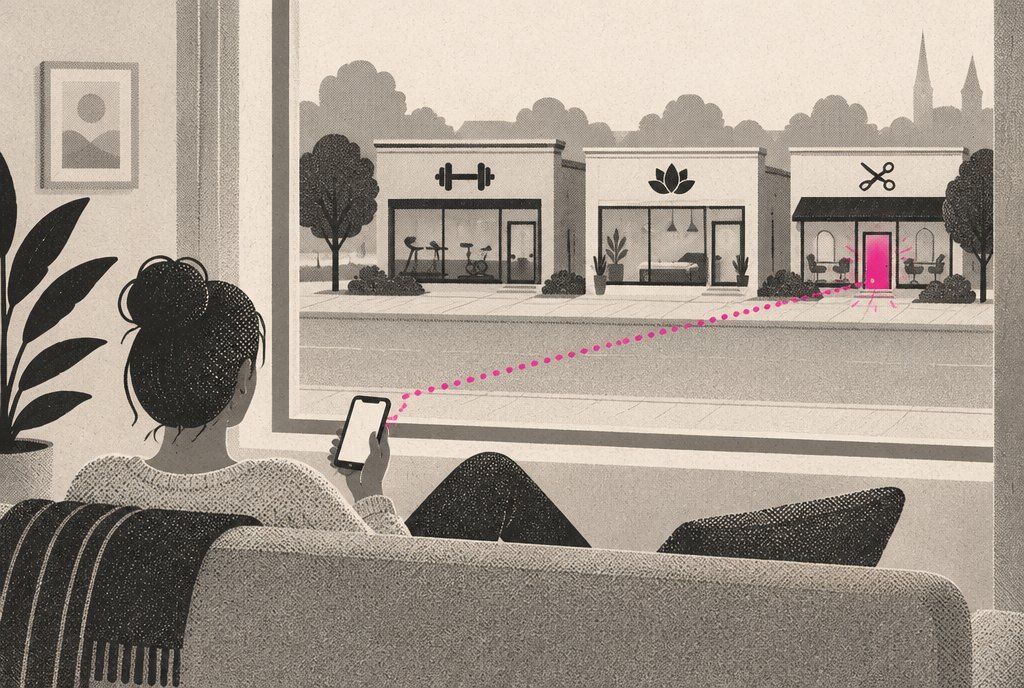
That person is starting to send someone else. They ask an assistant to find a pilates class near the office on Saturday morning, or a facial next week under $150, and the assistant goes and looks. It reads your site, compares you with three others, and either books you or moves on. The customer may never see your homepage at all.
This series is about that shift. We call it going beyond the four walls: your business still lives in a building, but more and more of the deciding now happens in software you do not control. Over ten parts we will look at the plumbing, the payments, and what Stripe, Meta, Amazon and Google are each building. Part 1 is the case that this is no longer a forecast.
Six weeks that made it real
Shopping agents have been in demos for a while. This September they started buying at scale, and the companies involved started fighting about it.
| Date (2026) | What happened |
|---|---|
| September 8 | Meta launched Muse, a personal AI agent that can complete tasks and make payments through Stripe's Link, which creates a one-time card for each purchase. |
| September 21 | Amazon blocked Muse from shopping on Amazon.com. Customers saw a pop-up saying an unauthorized AI agent violates Amazon's Conditions of Use. |
| September 24 | BrightEdge reported that referral traffic from ChatGPT had doubled since January. |
| September 30 | Mastercard expanded Agent Pay with a score that estimates whether an AI agent started a transaction. |
| October 7 | Forter's data showed agent orders running at 4.4 times their early-August level. |
Third-party agents "should operate openly and respect service provider decisions about whether or not to participate."
Read that Amazon line again, because it is the whole argument in one sentence. The largest store in the world now has a stated policy on which robots may shop with it. Amazon has a legal team for that. A three-location med spa does not, but the same question is arriving at its door.
The numbers, without the hype
There is a lot of breathless forecasting about agentic commerce. Here is what was actually measured this year.
Source: BrightEdge, Forter via Opus Research, Checkout.com via FinTech Weekly
Both things are true at once. Agents are still a small share of what gets bought: Checkout.com's merchants say 3% of their transactions involve one. And that share is climbing fast. Forter, which screens orders for a large network of online merchants, watched agent orders more than quadruple in eight weeks, and Meta's Muse alone placed two thirds as many orders in its first eight days on the network as Forter had seen from every agent in the month before.
Source: BrightEdge, September 24, 2026. Standalone AI assistants only; Google's AI Overviews and AI Mode are measured separately.
The other number worth knowing comes from PYMNTS Intelligence, as reported by Forkast: about 132 million American adults have now used AI to help with a retail purchase, and roughly six in ten of those purchases still end on Amazon.
Source: PYMNTS Intelligence survey of 2,000+ consumers, September 2026, as reported by Forkast
That dot grid is the warning. When the assistant does the choosing, it goes where buying is easy. For products that means Amazon. For appointments, it means whichever business an agent can actually book.
It has already reached the appointment book
You might think this is a retail story that will reach gyms and spas eventually. It already has.
Last November Google said its AI Mode can book beauty and wellness appointments for US users in its Search Labs program. It finds live availability and hands off to booking platforms it named: Booksy, Fresha and Vagaro. Restaurant reservations came first, through partners like OpenTable. Salons, spas and wellness are now on the list.
On the payments side, Stripe's documentation now explains how browser agents can complete payment on Stripe's own checkout pages through WebMCP, a proposed web standard that lets a page hand an agent a short list of things it can do, instead of making it guess where to click. Stripe calls it experimental. It also tells agents to get the person's confirmation before they pay. Both details matter. The rails are being laid carefully, by the people who move the money.
What changes for a business with four walls
None of this replaces the studio, the spa or the gym. People still have to walk in to sweat, to get the facial, to have the consult. What moves is everything before the walk-in: being found, being compared, being chosen, being booked.
How a customer found you
They searched, scrolled, clicked your ad or your listing, judged your photos, and maybe filled in a form. Your website persuaded a person.
How an assistant finds you
It reads your hours, prices, location and availability, checks whether it is allowed in, compares you with three nearby options, and books the one it can complete. Your website answers a machine.
That second column has some uncomfortable consequences:
- Persuasion matters less than plumbing. An agent does not admire your hero video. It needs your opening hours as data, not as a picture of a sign.
- Blocked means invisible. When we scanned 98 fitness and wellness brand websites this month, none blocked the live assistants in robots.txt. But 18 of them sat behind a security wall that shows a "checking your browser" page an agent cannot get past. Our own new website was turning away ChatGPT and Claude's assistants until we checked. Here is what that scan found.
- Bookable beats beautiful. If the assistant can finish a booking with your competitor and cannot finish one with you, the decision is made before anyone sees either website.
- Your booking platform is now part of your marketing. If an agent can reach your availability through the platform you already use, you are in the running. If your booking lives in something no agent can read, you are not.
What to do this month
You do not need a new website. You need to check four things on the one you have.
In Part 2 we open up the plumbing: what robots.txt, structured data, llms.txt, MCP and WebMCP actually are, in plain English, and which of them a local business should care about first. If you want the short version now, The four questions an AI agent asks your website covers the checklist.
Sources
- BrightEdge, "ChatGPT Referral Traffic More Than Doubles in 2026," September 24, 2026. brightedge.com
- Opus Research, "Agentic Commerce Is Starting to Leave a Trail," October 7, 2026, on Forter's order data. opusresearch.net
- FinTech Weekly, "Agentic Commerce Had Its Biggest Launch Month," October 4, 2026, for Checkout.com's survey and Mastercard Agent Pay. fintechweekly.com
- The Paypers, "Meta launches personal AI agent with Stripe-powered checkout," September 9, 2026. thepaypers.com
- Adweek, "Amazon locks out Meta's Muse in agentic shopping standoff," September 21, 2026. adweek.com
- Forkast, reporting PYMNTS Intelligence, September 2026. forkast.news
- Google, "Explore new ways to plan and book travel with AI in Search," November 17, 2025. blog.google
- Stripe, "Use WebMCP to complete Stripe payments in a browser." docs.stripe.com