Blog Inside Sneeze It · Inside Audience · Part 2
A circle is not a trade area. Why we draw real drive times.
The three-mile radius is the most common map in site selection, and it is wrong in ways you cannot see on the map. Here is how Audience draws the market instead, and what changed when it did.
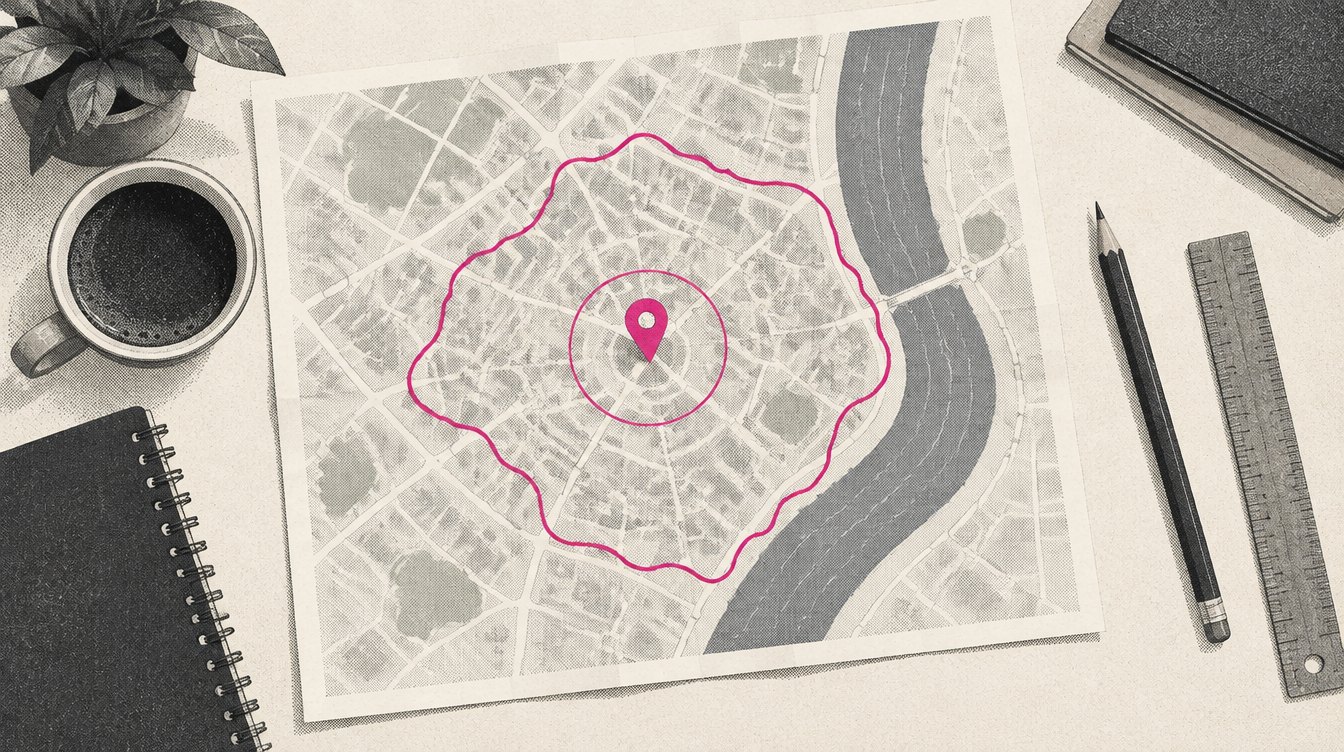
Open almost any site report for a gym, studio or med spa and you will find the same picture: a pin, and a circle around it. Three miles, sometimes five. Everyone inside the circle is "your market". Every competitor inside it is "your competition".
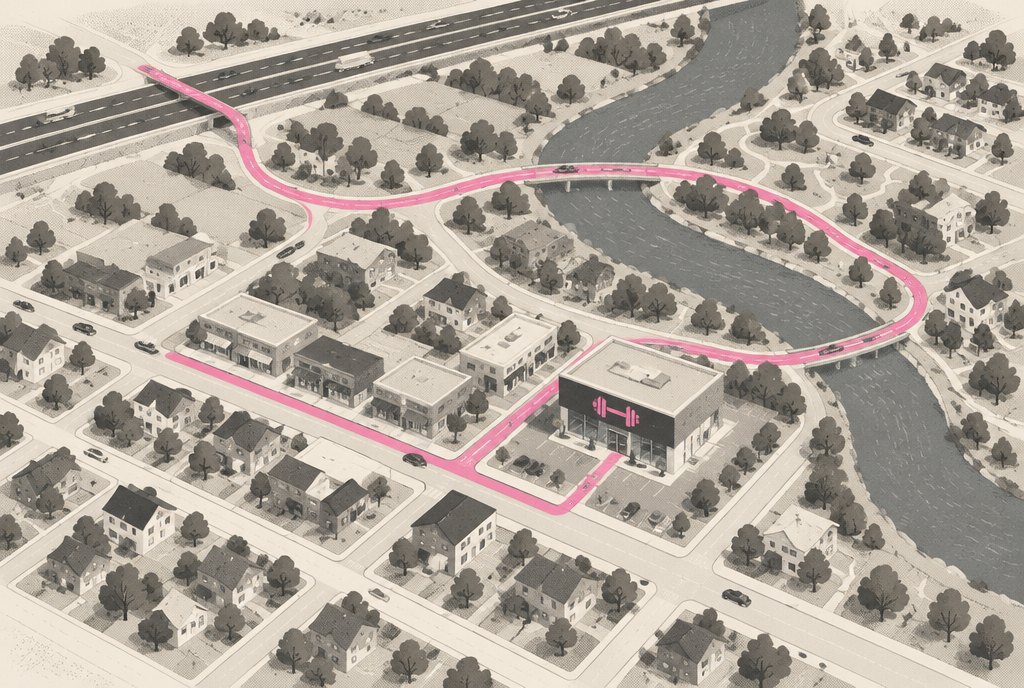
The circle is popular because it is easy to draw. It is also wrong, in a way that is invisible on the map. It ignores rivers and highways. It ignores the fact that ten minutes north might be four miles of open road, and ten minutes east might be one mile of school traffic. People do not choose a gym by straight-line distance. They choose it by how long it takes to get there.
So the first thing Audience, our market tool, does with an address is throw the circle away.
Source: Audience, About and the live homepage
What a circle gets wrong
We tested the two side by side. For one site, the radius circle overstated the population that could actually reach the location by 60%. It also invented six competitors: businesses that sat inside the line but outside any realistic drive for the people who lived there.
Both errors push in the same direction. A bigger population makes a site look more promising. More competitors make it look more contested. A franchise team reading that report would be weighing a market that does not exist.
The three-mile circle
Everyone within three miles as the crow flies. Rivers, highways and one-way traffic ignored. Competitors counted if their pin falls inside the line.
The drive-time trade area
Everyone within a 5, 10 and 15 minute drive on real roads. The shape bends around barriers and stretches along fast roads. Competitors counted only if people can reach them.
People do not choose a gym by straight-line distance. They choose it by how long it takes to get there.
How Audience draws the market
Audience draws three drive-time areas around the address, for 5, 10 and 15 minutes over the actual road network. Those shapes become the frame for everything else in the study.
- 1AddressThe site you are weighing
- 2Drive time5, 10 and 15 minutes on real roads
- 3PeopleResidents counted from census blocks inside the shape
- 4CompetitorsEvery business inside the drive, checked still open
- 5OverlapHow much of your market a competitor also reaches
People, not land. A ZIP code that is half inside the drive does not count as half its population. Since October 2, 2026, Audience counts residents from the 2020 Census at block level, so a ZIP whose homes all sit on the far side of a highway counts for what it actually holds, not for its land area.
Competitors that are really there. Audience carries its own index of 838,922 US businesses: gyms, salons, spas, med spas, barbers, martial arts studios and more. Every competitor inside the drive is listed with its distance and drive time, then checked against Google Maps so closed or mislisted places drop out. Competitors are defined by what the customer buys, so a blowout bar is compared with salons and lash studios, not with barbers.
Overlap, not just proximity. A pin on a map tells you a competitor is nearby. Audience also draws each competitor's own drive-time area and measures how much of your trade area falls inside it. "A large share of your market is also inside a competitor's ten-minute drive" is a different conversation from "there are six gyms nearby".
Honest about the fallback. If no drive-time service answers, Audience can still fall back to a straight-line radius. When it does, the report says so by name, so a radius run is never mistaken for a drive-time run.
The same discipline, all the way down
Once you stop trusting the circle, you start noticing other places where a map number is not what it seems.
Ad reach. When we asked Meta how many people it could reach in one ZIP code, the answer was roughly 290,000 to 341,000. Counting only people whose home is in that ZIP, rather than anyone recently there, brought it down to roughly 15,100 to 17,800. For a local business, the smaller number is the one that matters. Audience now uses home location only for reach estimates on the same rings.
Source: Audience, one ZIP code tested, low end of each range shown
Crowded metros. In a dense metro, a seven-mile ring can hold 440 gyms. A list that long is not a competitive picture; it is noise. Audience caps its analysis at 100 competitors per ring.
What "not measured" means. If a lookup fails, the report shows "not measured", never zero. A zero would read as "no competitors" or "no audience", which is a claim, not a gap.
What it changes for a franchise team
For a franchisor weighing a new territory, the drive-time area changes three decisions.
The first is the site itself. Two addresses a mile apart can have very different markets if one sits on the near side of a highway. The circle draws them the same. The drive time does not.
The second is territory. If franchise territories are drawn by radius, two franchisees can be promised overlapping markets, or a single franchisee can be promised households they cannot realistically serve. Drive time gives both sides a fairer line.
The third is the media plan. Audience estimates digital reach for the same rings the market study drew, so the forecast and the plan to fill the location describe the same households.
The trade area is also where the forecast begins. We explain how Audience predicts enquiries for a new site, and why it uses comparable locations rather than demographics, in Demographics did not predict cost per lead. For how this fits with the rest of our tools, see Inside One.
Audience is live and used by our team. Its public homepage shows a full sample market study, drive-time rings included, on an invented address.