Blog Franchise Growth · The Franchise Growth Playbook · Part 3
Trade areas that respect the drive, the competition and your own locations
A franchisor's playbook for drawing territories by drive time, checking which competitors are really there, and spacing new locations so they grow the system instead of splitting it.

Most territory maps in franchising are drawn for the franchise agreement, not for the customer. A radius, a list of ZIP codes, a county line. Those boundaries settle who may open where. They say very little about who will actually drive to the door, which competitors those people already use, or whether your next location will take members from your last one.
Those three questions decide whether a new site adds to the system or redistributes it. This playbook answers them in order: draw the market by drive time, check the competition that is really inside it, then measure how much the new site overlaps your own locations.
Source: Audience competitor index of 838,922 US businesses, counted October 10, 2026. audience.sneeze.it
Draw the market by the drive, not the boundary
People choose a gym, a studio or a med spa by how long it takes to get there. A drive-time trade area follows real roads: it stretches along fast routes and stops at rivers, rail lines and highways without crossings. A radius ignores all of that. On one site we tested, a circle overstated the population that could reach the location by 60%. We explained that test in A circle is not a trade area; the franchisor question is what to do about it.
Keep two maps, and do not confuse them. The territory is a legal and commercial line in the franchise agreement. The trade area is a description of where customers come from. A territory can stay as it is while every planning decision inside it is made on drive times. What changes is the evidence the development team brings to a site approval, a territory dispute or a marketing budget.
Draw three rings for every location and every proposed site: 5, 10 and 15 minutes on real roads. Count the people who live inside each ring from census blocks, not ZIP land area, because a ZIP that is half inside the drive may hold most of its homes on the far side.
Territory as the map
A radius or ZIP list drawn for the agreement. Every resident inside counts as market. Every competitor inside counts as competition. Two locations "do not overlap" because their territories do not touch.
Drive time as the map
5, 10 and 15 minute rings on real roads. Only reachable residents count. Only reachable competitors count. Two locations overlap when their drive times share households, whatever the agreement says.
Check the competition that is actually there
A competitor list is only useful if it is true. Three checks matter.
Is it inside the drive? A competitor counts when your customers can reach it in the same drive time they would use to reach you. A business across a river with no nearby bridge may be one mile away and twenty minutes off.
Is it still open? Business directories hold places that have closed, moved or were listed under the wrong category. Every competitor should be checked against a current map listing before it appears in a report. A closed competitor counted as open makes a market look more crowded than it is.
Does it sell what your customer buys? Define competitors by the purchase, not the business category. A blowout bar competes with salons and lash studios, not with barbers. A recovery studio may compete with day spas and some med spas, and not with a big-box gym.
Scale is the reason this has to be systematic. Audience's index holds 838,922 US businesses across gyms, salons, spas, med spas, barbers, martial arts and more. In a dense metro, a seven-mile ring can hold 440 gyms, which is why the tool caps the analysis at 100 competitors per ring. Nobody reads 440 competitors by hand. A franchisor running dozens of site reviews a year needs the same three checks applied the same way every time.
A territory settles who may open where. A trade area tells you who will actually drive to the door.
The playbook
- Draw 5, 10 and 15 minute rings for every open location
Do this once for the whole system and refresh it when a location moves or a major road opens. Store the rings with each location's record.
- Draw the same rings for the proposed site
Same drive times, same method, same population count. A site measured with a different ruler cannot be compared.
- List competitors inside each ring, checked still open
Keep only businesses that sell what your customer buys. Record distance and drive time for each.
- Measure overlap with your own locations
For each open location near the proposed site, count the households that fall inside both locations' ten-minute rings. Express it as a share of the proposed site's ten-minute households.
- Measure overlap with your strongest competitors
Draw the same ring around each major competitor and measure how much of your proposed market sits inside it. "A large share of your market is inside a competitor's ten-minute drive" is a sharper finding than "there are six gyms nearby".
- Write the finding as one sentence per ring
For example: "Inside 10 minutes, about a third of households are already inside our nearest location's 10-minute drive, and two direct competitors are open." That sentence goes to the approval meeting.
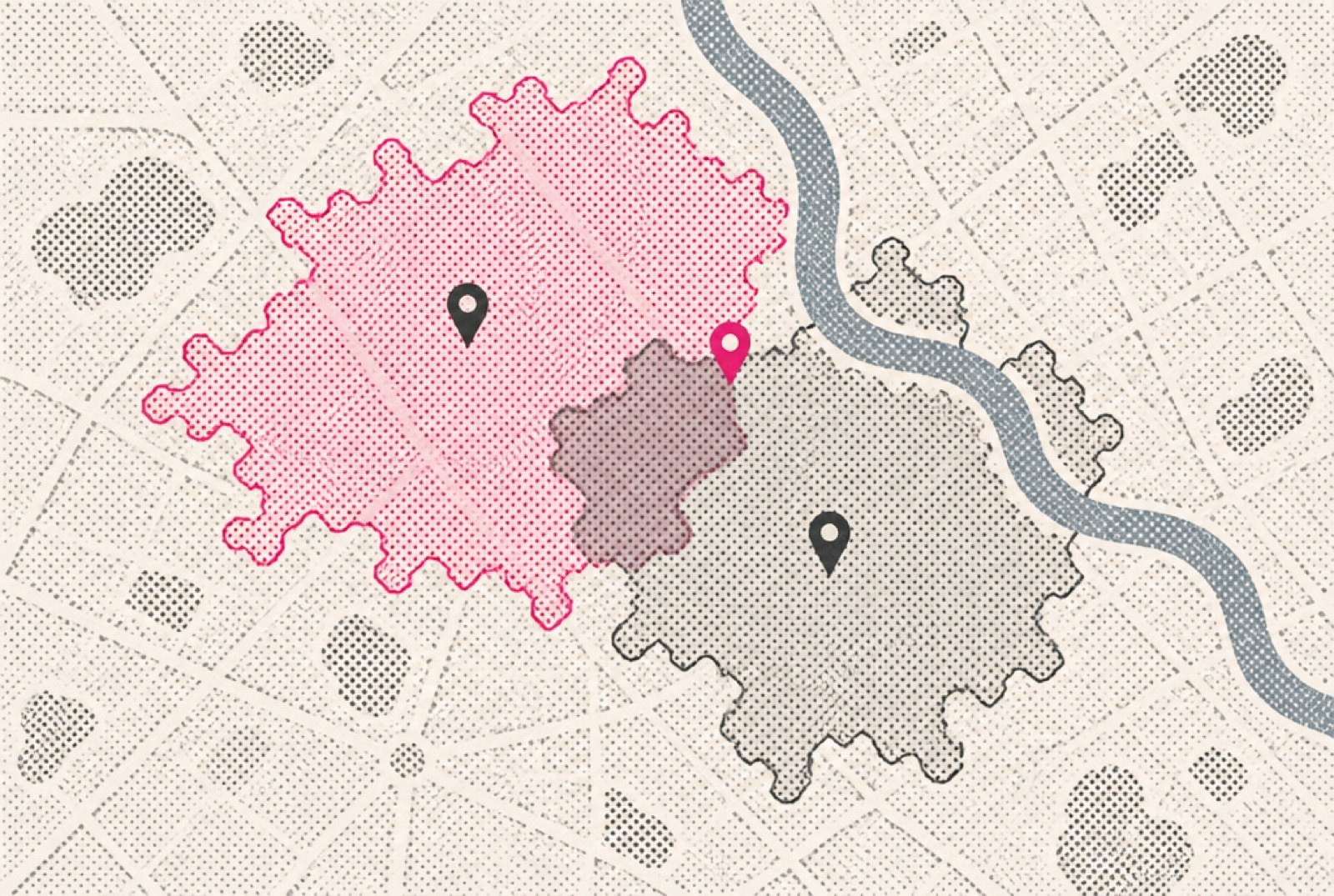
Cannibalization, with arithmetic
Cannibalization is the question franchisees ask loudest and franchisors measure least. Drive-time overlap makes it countable.
Say a proposed site has 30,000 households inside its ten-minute ring. Your nearest open location's ten-minute ring covers 9,000 of those same households. That is 30% overlap. A second open location covers another 3,000, so 40% of the proposed market already sits inside a short drive of one of your doors.
That does not mean the site is wrong. It means the honest forecast has two parts: members the new site wins from households you do not reach today, and members it moves from your existing locations. A development team that reports only the first part will approve sites that grow the unit count and flatten average unit volume. (These numbers are illustrative, not from any system.)
Two policies follow from this:
- Set an overlap threshold before you need one. Decide what share of shared ten-minute households triggers a review with the affected franchisee. Agreeing the number in advance is easier than agreeing it during a dispute.
- Talk to the neighboring owner with the map, not the territory. Show the overlap in households. It turns an argument about lines into a discussion about people.
What to measure, and what to do this quarter
Three numbers tell you whether your trade-area practice is real:
- Share of locations with drive-time rings on file. If it is not every open location, overlap cannot be measured for the next site.
- Overlap share at approval. Record the overlap with your own locations for every approved site, then compare it with how the neighboring location performed in the twelve months after opening.
- Competitor list age. The date each site's competitor list was last checked against live listings. A list older than the lease negotiation is a risk.
Trade areas also shape marketing after opening. The same rings decide where local ads should run, which is why we size geography, not demographics, for local campaigns; our demographics test found the neighborhood profile did not predict what a lead would cost.
Start this quarter with the locations nearest your next three proposed sites. Draw their rings, measure the overlap, and bring the household counts to the approval meeting. If you want drive times, checked competitors and their live offers from a single address, Audience does that.